A1 Complete

A2 — You Are Here

You're no longer a complete beginner. That changes everything.

A2 is where English stops feeling like a mystery and starts feeling like a tool. You can handle real daily situations — not perfectly, but genuinely. That’s a bigger deal than it sounds.

words in your vocabulary
0 +
hours to reach A2
100 - 180 0
of 6 on CEFR scale
Level 0

A1

Beginner

Basic phrases, self-introduction, survival English

A2

Elementary — You're here

Daily routines, simple conversations, past & future tense

B1

Intermediate

Handle most travel, express opinions, understand main ideas

B2

Upper Intermediate

Fluent in familiar topics, nuanced communication

C1

Advanced

Effortless expression, complex texts, near-native

C2

Mastery

Full proficiency — every nuance, every register

A2

01 ———— What is A2

The official definition — and what it actually means.

The Council of Europe’s definition is technically correct. But it doesn’t explain why A2 feels meaningfully different from A1 — or why it matters.

Official CEFR Definition

Can communicate in simple and routine tasks requiring a simple and direct exchange of information on familiar and routine matters.
“Can describe in simple terms aspects of their background, immediate environment and matters in areas of immediate need.” — Council of Europe

What it actually feels like

You can hold your own. Not perfectly — but genuinely.

At A2, English stops being a collection of memorized phrases and starts being a language you actually use. You can talk about your life, make plans, tell a short story about your week, and navigate most everyday situations without freezing up.
The jump from A1 to A2 is one of the most satisfying in language learning — because for the first time, real conversations become possible.
The real difference from A1

A1 was survival. A2 is participation. You're no longer just reacting to English — you're actually using it to get things done, share your thoughts, and connect with people.

02 ———— Identify Yourself

You're probably at A2 if…

These real moments are more revealing than any grammar test. How many of these feel familiar?

✓ Familiar

speck | English Explorers

You can talk about your week — "On Saturday I went to the market and I bought some vegetables" — with occasional pauses and small errors, but you get through it.

✓ Familiar

phone2 | English Explorers

You can text a colleague or friend in English — short messages feel manageable now. You don't panic at every notification the way you did before.

✓ Familiar

flyt | English Explorers

You can navigate an airport, hotel, or tourist situation almost entirely in English — asking for help, understanding announcements, reading signs — without major stress.

✗ Not quite yet

voice | English Explorers

You still can't follow a conversation between two native speakers talking at normal speed. When people stop accommodating you and just speak naturally, you lose the thread quickly.

✓ Familiar

icon16 | English Explorers

You can read short emails and messages without a dictionary — especially if the topic is work, plans, or everyday life. Longer texts still require a lot of effort.

✗ Not quite yet

icon11 | English Explorers

Jokes, sarcasm, and cultural references still mostly land flat. You can tell something was supposed to be funny — but why it's funny often escapes you. This is genuinely a B1+ thing.
03 ———— Real-Life Abilities

What you can actually do right now.

A2 unlocks a surprisingly wide range of real communication. Here’s what’s genuinely within your reach today.

01

Talk About Your Past

Use past tense to share experiences, tell short stories, and describe things that happened to you.

“Last weekend I went to a festival with my friends. It was really fun but very crowded.”

02

Make & Change Plans

Coordinate with people — suggesting, agreeing, rescheduling. The back-and-forth of real life scheduling.

“Can we meet at 3 instead? I have a meeting until 2:30. Is that OK?”

03

Describe Your Life

Talk about your job, family, routine, likes, dislikes — the building blocks of actually knowing someone.

“I work in an office from 9 to 6. I live with my partner. I really like hiking on weekends.”

04

Talk About Your Past

Use past tense to share experiences, tell short stories, and describe things that happened to you.

Lorem ipsum dolor sit amet, consectetur adipiscing elit. Ut elit tellus, luctus nec ullamcorper mattis, pulvinar dapibus leo.

05

Talk About Your Past

Use past tense to share experiences, tell short stories, and describe things that happened to you.

Lorem ipsum dolor sit amet, consectetur adipiscing elit. Ut elit tellus, luctus nec ullamcorper mattis, pulvinar dapibus leo.

06

Talk About Your Past

Use past tense to share experiences, tell short stories, and describe things that happened to you.

Lorem ipsum dolor sit amet, consectetur adipiscing elit. Ut elit tellus, luctus nec ullamcorper mattis, pulvinar dapibus leo.

04 ———— Everyday Communication

How A2 actually communicates today.

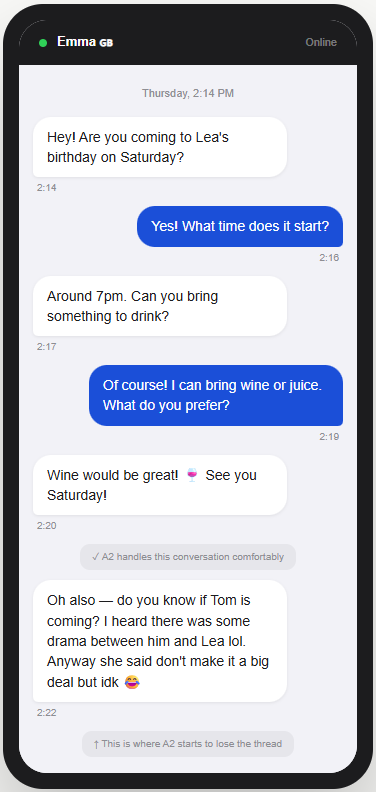
Communication in 2025 is not just talking — it’s texting, messaging, commenting, and coordinating. Here’s the full CEFR A2 English level picture.

CEFR A2 English level
The chat shows something real — A2 handles structured, purpose-driven conversation very well. It’s the casual, fast, culturally loaded language that starts to slip.
💬 Messaging — A2 is comfortable with:
📱 Social media — the A2 reality:
🚧 Where A2 still struggles:

05 ———— Listening & Reading

Your passive skills at A2.

This is where most learners are silently stronger than they give themselves credit for. A2 passive skills are broader than you think.
music1 | English Explorers
Listening

Slow, clear speech in familiar contexts

Short videos and tutorials on familiar topics — cooking, travel, how-to content — especially with visuals that reinforce meaning.

Following a YouTube recipe in English without subtitles — you catch most of the key steps.

Predictable dialogue — customer service calls, check-in conversations, interviews on simple topics.

"What's your name? How long are you staying? Do you need a wake-up call?"

Familiar accents at moderate speed — especially when the topic is something you know well and the speaker is accommodating.
Authentic native-speed conversation between two people not speaking for your benefit — contractions, mumbling, slang and all. Still largely inaccessible.
book2 | English Explorers
Reading

Short texts in familiar, concrete contexts

Emails and messages — especially professional ones where language is usually clear and structured.

"Please find attached the document you requested. Let me know if you have any questions."

Short articles and social posts on familiar topics — food, travel, basic news. You might need a word or two, but you get the main point.
Instructions and guides — recipes, product manuals, how-to posts. The format helps a lot.

"Preheat the oven to 180°C. Mix the flour and butter until smooth."

Opinion pieces, complex news, or creative writing — too much assumed vocabulary and cultural context. Save this for B1+.

06 ———— Speaking & Writing

How you express yourself at A2.

A2 gives you real tools — not just memorized phrases, but actual flexible language you can adapt to different situations.
specking | English Explorers
Speaking

Connected sentences, real topics, small errors

Unlike A1, you can now link ideas together — “I went to the market because I needed vegetables” is a real A2 sentence. You make mistakes with tenses and prepositions, but communication doesn’t break down.

"I went to the cinema last night — it was really good."

past event

"I'm planning to visit my family next month."

future plan

"I think this one is better because it's cheaper."

opinion + reason

"Sorry, could you say that again more slowly?"

repair strategy

"I usually wake up at 7 and then I have coffee."

routine

Honest truth: Your written A2 English will be read and understood by native speakers without difficulty. That's a genuinely useful skill — don't underestimate it.

Writing | English Explorers
Writing

Short texts, personal topics, connected ideas

A2 writing is where many learners surprise themselves. With time to think and edit, you can produce clear, purposeful texts that actually communicate what you mean.

"Hi! I can't come on Friday because I have a doctor's appointment."

excuse

"The apartment is small but it has a nice balcony and it's close to the metro."

description

"I really enjoyed the trip. The food was amazing and the people were very friendly."

review

"Can we meet on Tuesday instead? I'm free from 2pm."

rescheduling

Honest truth: Your written A2 English will be read and understood by native speakers without difficulty. That's a genuinely useful skill — don't underestimate it.

07 ———— Vocabulary & Grammar

What actually matters at A2.

You’ve tripled your vocabulary since A1. Now it’s about using the grammar structures that unlock real, flexible communication.

1,500+ words

That’s your A2 vocabulary range — and the jump from A1’s ~600 is significant. These extra words are the difference between “I am tired” and “I had a really exhausting week.”

Your word bank now covers daily life in real depth: describing people, places, events, feelings, and simple opinions. You can be specific, not just general.

Daily routines

Past experiences

Numbers & time

Future plans

Health & body

Transport & travel

Work & study

Money & shopping

Weather & seasons

Feelings & opinions

Comparisons

Common phrasal verbs

Past Simple

BIGGEST UNLOCK

The single biggest jump from A1. Now you can tell stories, share experiences, and have conversations about real events.

I went / she didn't come / did you see?

"I visited my parents last weekend. We had dinner together."

Going to / Will

FUTURE PLANS

Talk about what’s coming — plans, intentions, and predictions. Essential for coordinating with people.

"I'm going to visit London next month." / "It will be cold tomorrow."

Comparatives & Superlatives

EXPRESS OPINIONS

Make decisions, share preferences, and evaluate things — a massive part of real daily conversation.

bigger / more expensive / the best / less crowded

"This hotel is more expensive but it's much nicer."

Modal Verbs

SOCIAL TOOL

Can, could, would, should — the verbs that make you sound polite, make requests, and ask for advice.

"Could you help me?" / "Should I call first?" / "Would you like a coffee?"

08 ———— Digital & Social Life

A2 English in the
places you already live.

Most of your English exposure isn’t in a classroom — it’s on your phone, your screen, your apps. Here’s the honest A2 picture across the platforms that matter.
cam | English Explorers
Instagram & TikTok

Content you consume daily

Visual context is your biggest ally. You’re stronger here than you think — especially in niches you care about, where vocabulary overlaps with your life.

can

Read and understand most lifestyle, food, travel captions

can

Leave real comments — not just “❤️” but actual sentences

can

Follow slow-paced “story time” or tutorial content

HARD

Current slang — “understood the assignment,” “no cap,” “it’s giving main character”

HARD

Fast comedy, irony, or anything where timing and delivery carry the meaning
work | English Explorers
Work Tools & Email

Slack, Teams, Gmail, Notion

Work English at A2 is surprisingly manageable — professional language is often formal, repetitive, and predictable, which plays to your strengths.

can

Write clear, professional emails for common situations

can

Respond to Slack messages, updates, short requests

can

Navigate app interfaces, menus, settings, prompts

HARD

Long complex threads with multiple topics and people

HARD

Casual office banter — “watercooler” language feels slippery
tube | English Explorers
YouTube & Netflix

Video content with and without subs

A2 is where English video content starts becoming genuinely enjoyable — especially with subtitles. Genre matters enormously here.

can

Follow documentary and how-to content with English subs Read and understand most lifestyle, food, travel captions

can

Understand slow-paced shows like cooking or travel shows

can

Catch the main plot of a simple drama with subtitles

HARD

Fast dialogue, overlapping speech, or heavy accents without subs

HARD

Stand-up comedy — entirely dependent on language nuance

09 ———— Work & Social

A2 in the situations that actually count.

Real situations, not textbook scenarios. Here’s what A2 actually looks like when it matters.

👋 Meeting new colleagues

A1 learners actually thrive here — video + image context fills in a lot of language gaps. You understand more than you think.

"Hi, I'm Maria. Nice to meet you. I work in marketing. And you?" — This is A1-doable, and it creates a real human connection.

❓ Asking for help at work

You can flag that you need something without necessarily being able to explain the full context. Simple, direct requests work just fine at this level.

"Excuse me, where is the printer?" / "Can you help me, please?" / "I don't understand. Can you repeat?"

📋 Following basic instructions

If instructions are given clearly and slowly — especially with demonstration — A1 learners can follow along and get the job done.

Nodding, pointing, and using "OK" and "yes" to confirm understanding. Not glamorous, but it works in a basic job environment.

📢 Understanding announcements

Workplace announcements — safety info, schedule changes, meeting reminders — are often short and repetitive, which A1 handles reasonably well.

"Fire drill today at 2pm. Please use the stairs." — Key words land even if the full sentence doesn't.

🎉 Being at a social event

Small talk formulas carry you further than you think. Most opening conversations follow predictable patterns that A1 handles well.

"Hi! I'm [name]. Nice to meet you. How do you know [host]?" — You'll get by, even if deeper conversation is harder.

🍽️ Going out to eat

Restaurants are an A1 comfort zone. The script is predictable, visual menus help, and staff are used to non-native speakers.

"A table for two, please." / "I'll have the pasta." / "Can I have the bill?" — Confidence wins here.

🗺️ Asking for directions

You can ask. Understanding the answer is the harder part — but pointing, looking at phones, and saying "sorry, can you show me?" all help.

"Excuse me, where is the metro?" is A1. What comes back might be harder — but most people will point.

🛒 Shoppin

One of the easiest A1 real-world scenarios. Predictable, repetitive, and context-rich. Signs, prices, and visual cues do most of the work.

"How much is this?" / "Do you have this in size medium?" / "I'll take it." — All completely within A1 reach.

10 ———— A Day in the Life

24 hours as an A2 learner.

What A2 English actually looks like woven through a real Tuesday — not a language exercise, but your actual life.

☀️ Morning routine

Your phone alarm goes off. The notification says "Reminder: meeting at 10am today." You understand it. You also see an Instagram post from a brand you follow — "Good morning! Happy Monday ☕" — and you get it, you like it.

English moments: phone notifications, simple social media captions — A1 handles both comfortably.

8:00 AM

☕ Getting coffee before work

You stop at a café. "One flat white, please." The barista asks "Do you want a receipt?" You catch "receipt" — you say yes. Small win. Total success.

English moment: Basic transaction in a predictable context. Context and visual cues fill in the blanks.

9:30 AM

💼 Work meeting

Your manager says something quickly and you catch the words "project," "Thursday," and "email." You nod. Later, you check the email — short and clear — and you understand what's expected.

English moment: You miss some of the spoken meeting but the written follow-up email is manageable. A1 in action.

10:00 AM

🥗 Lunch — navigating a food truck

The menu is simple. You order "the chicken wrap, please." The person asks "Is that for here or to go?" — you've heard this before. "To go, please." Done.

English moment: Learned phrases do real work here. This is exactly why A1 vocab is worth building.

1:00 PM

📺 Evening — Netflix with subtitles

You put on an English-language show with English subtitles. You don't understand everything but you pick up words you know — "stop," "help," "I love you," "tomorrow." The visual story carries you through the rest.

English moment: Passive learning that actually works. This is one of the most effective things an A1 learner can do.

7:00 PM

11 ———— A Day in the Life

24 hours as an A2 learner.

What A2 English actually looks like woven through a real Tuesday — not a language exercise, but your actual life.

60–100

Hours of guided study

15–30

Minutes per day is enough

8–12

Weeks on average

What moves the needle at A2

icon15 | English Explorers

Talk to real people (even if it's terrifying)

Language exchange apps like Tandem or HelloTalk. Even 15 minutes of real conversation accelerates progress more than hours of passive study.

icon14 | English Explorers

English content you actually enjoy

Watching with English subtitles is proven to build vocabulary fast. Pick a show you'd watch anyway — just switch the audio and subs.

write | English Explorers

Keep a simple journal in English

Narrate your day in English. "I am making coffee. It is hot. I am tired." Sounds silly, works incredibly well.

icon16 | English Explorers

A1 graded readers

Books written exactly for your level — enough challenge to grow, not so much that it's a slog. Penguin and Oxford Bookworms both have excellent A2 series.

Your next level: B1

B1 is where English stops being effortful and starts feeling like something you actually have. Here's what crossing that line gives you.

A2

trand | English Explorers

Real conversations — even about abstract topics

B1 speakers can discuss hopes, opinions, and experiences without scripting everything in advance. Spontaneity arrives at B1.

date | English Explorers

You start getting the jokes

Humour, irony, and cultural references start landing. This is one of the most satisfying moments in a language learning journey.

heat | English Explorers

TV and podcasts without subtitles become possible

Not everything — but familiar genres at moderate speed. A huge milestone that opens up your English content world.

chat | English Explorers

Get recognised if you need it

Cambridge A2 Key (KET) formally certifies your level. Useful for university applications, visa processes, or CV evidence.

11 ———— A Day in the Life

24 hours as an A2 learner.

What A2 English actually looks like woven through a real Tuesday — not a language exercise, but your actual life.

5 minutes · No sign-up · Covers all 6 CEFR levels

Sample questions from the quiz:

Which sentence is correct?

A

“Yesterday I go to the market.”

B

“Yesterday I went to the market.” ✓

c

“Yesterday I have gone to the market.”

You want to reschedule a meeting. What do you say?

A

“Meeting not possible.”

B

“Could we reschedule for Thursday?” ✓

c

“I would have preferred if we were to consider…”