
• CEFR A1 English Level
You're at the start of something real.
Words you'll learn at this level
Hours of study to reach A1
A1 → A2 → B1 → B2 → C1 → C2 — you're on the first step of a mapped, achievable journey
A1
01 — What is A1 —————
The real definition,
not just the textbook one.
Official CEFR Definition
What it actually means
You can survive in English — and that's more powerful than it sounds.
A1 is the beginning, not the bottom. It's your first working version of a second language — imperfect, functional, and genuinely impressive.
02 — Identify Yourself —————
You're probably at A1 if…
Sounds familiar ✓

You can introduce yourself confidently — name, where you're from, what you do — but panic the moment someone asks a follow-up question you didn't prepare for.
Sounds familiar ✓

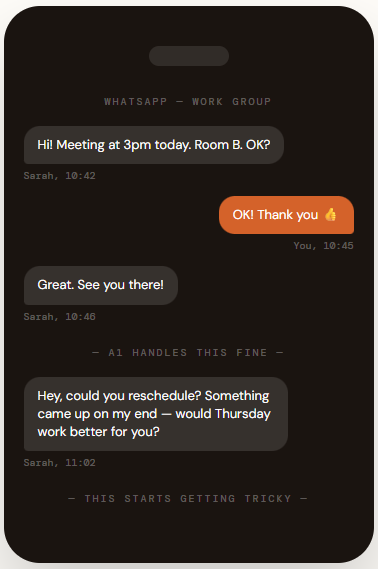
You can understand a basic text message like "I'm on my way" or "be there at 7" but a voice note from a native speaker at normal speed is basically a mystery.
Sounds familiar ✓

You've successfully ordered at a café in English — but when they said "would you like room for cream?" you just said yes without knowing what it meant.
Sounds familiar ✓

You can't follow TV shows even with subtitles turned off. Even slow, clear speech is mostly sounds to you right now — and that's completely normal at this stage.
Sounds familiar ✓

You can't hold a real back-and-forth conversation about anything that goes off-script. Unexpected questions or topic changes still throw you completely.
Sounds familiar ✓

You can read short, simple signs and menus and understand the gist — but a paragraph of English text requires a lot of stopping, re-reading, and Googling.
03 — Real-Life Abilities —————
What you can actually do at A1 — right now.
01
Introduce Yourself
Share your name, where you're from, what you do, and a few basic facts about yourself.
"Hi, I'm Marco. I'm from Italy. I work in a restaurant."
02
Ask Simple Questions
Get information you need using basic question structures — especially when you can point at things.
"Excuse me, where is the bathroom?" / "How much is this?"
03
Handle Basic Transactions
Buy things, order food, and manage simple exchanges — especially when the setting is predictable.
"One coffee, please." / "Can I have the bill?"
04
Follow Basic Instructions
Understand directions and simple commands when they're spoken slowly and clearly.
"Turn left." / "Open the door." / "Please wait here."
05
Use Common Social Phrases
Navigate polite social moments — greetings, goodbyes, thank yous — without freezing.
"Nice to meet you." / "See you later!" / "Thanks so much."
06
Describe Your Immediate World
Talk about the things physically around you using basic nouns, colors, and simple adjectives.
"It's a big red bag." / "My room is small but nice."
04 — Everyday Communication —————
English in the real world, at A1.
💬 Text & messaging — A1 can handle:
- Short confirmations — "Yes," "OK," "See you then"
- Basic emoji responses (the universal language)
- Simple questions with yes/no answers
- Sending your location or a time
📱 Social media — what you can navigate:
- Understanding captions with simple words
- Liking and leaving a basic comment ("Nice!" "Beautiful!")
- Reading notifications and app menus
- Following accounts — even if you don't catch every word
🚧 Where A1 starts to struggle:
- Sarcasm, jokes, or casual slang in captions
- Multi-sentence messages with complex ideas
- Voice messages at natural speaking speed
- Group chats that move fast
05 — Listening & Reading —————
What your ears and eyes can do at A1.

Slow, clear speech in familiar contexts
"Attention please. The train to London departs from platform 4."
Catching "three thirty" or "$12.50" in a mostly incomprehensible sentence.
Hearing "coffee," "please," "sorry," "help" in everyday situations.

Short texts in familiar, concrete contexts
"EXIT," "PUSH," "Allergens: contains nuts," "$4.50"
"Hi! I'm at the café. Where are you? Call me."
Reading "Monday, March 3 at 2:30pm" without help.
06 — Speaking & Writing —————
How you express yourself at A1.

"I like coffee."
preference
"Where is the train?"
asking directions
"My name is Ana. I'm from Brazil."
introducing yourself
"Sorry, can you repeat?"
buying time — crucial
Honest note: You'll pause. You'll say "um" a lot. You might mix up word order. None of that stops communication — and native speakers appreciate the effort more than you think.

"My name is Carlos. I am 28."
form or profile
"I live in Madrid. I have one sister."
about yourself
"OK. See you at 5. Thank you!"
text message
"I am on holiday. The weather is hot."
postcard / caption
Honest note: You'll make grammar mistakes — that's not just expected, it's necessary. People who never make mistakes are people who never try.
07 — Vocabulary & Grammar —————
What actually matters at this level.
~600 words
That’s your A1 vocabulary range. It sounds small — and it is — but these 600 words cover the situations you’ll actually be in every day. Quality over quantity matters far more at this stage than trying to cram lists.
Your word bank covers the essentials: who you are, where you are, what you need, and how you feel.
People & family
Food & drink
Numbers & time
Colors & sizes
Places & directions
Feelings
Daily objects
Jobs
Weather
Shopping
Verb "to be"
PRIORITY #1
I am / You are / She is / They are
"I am a teacher." / "She is from Japan."
Present Simple
DAILY USE
I work / She likes / They live
"I work in a school." / "He likes pizza."
Basic Questions
SURVIVAL TOOL
What? Where? Who? When? How much? How many?
"Where is the exit?" / "How much is this?"
There is / There are
DESCRIBE THINGS
"There is a café near here." / "There are two bedrooms."
08 — Digital & Social Life —————
English online — the A1 reality.
Instagram / TikTok
Following along visually
A1 learners actually thrive here — video + image context fills in a lot of language gaps. You understand more than you think.
can
can
hard
WhatsApp / iMessage
Texting in English
Short message formats are actually ideal for A1. The structure is simple, context is clear, and there's time to think.
can
can
can
YouTube / Netflix
Watching with support
Video with subtitles is one of the best A1 learning tools available — and you might enjoy it more than you expect.
can
can
hard
02 — Identify Yourself —————
You're probably at A1 if…
👋 Meeting new colleagues
A1 learners actually thrive here — video + image context fills in a lot of language gaps. You understand more than you think.
"Hi, I'm Maria. Nice to meet you. I work in marketing. And you?" — This is A1-doable, and it creates a real human connection.
❓ Asking for help at work
You can flag that you need something without necessarily being able to explain the full context. Simple, direct requests work just fine at this level.
"Excuse me, where is the printer?" / "Can you help me, please?" / "I don't understand. Can you repeat?"
📋 Following basic instructions
If instructions are given clearly and slowly — especially with demonstration — A1 learners can follow along and get the job done.
Nodding, pointing, and using "OK" and "yes" to confirm understanding. Not glamorous, but it works in a basic job environment.
📢 Understanding announcements
Workplace announcements — safety info, schedule changes, meeting reminders — are often short and repetitive, which A1 handles reasonably well.
"Fire drill today at 2pm. Please use the stairs." — Key words land even if the full sentence doesn't.
🎉 Being at a social event
Small talk formulas carry you further than you think. Most opening conversations follow predictable patterns that A1 handles well.
"Hi! I'm [name]. Nice to meet you. How do you know [host]?" — You'll get by, even if deeper conversation is harder.
🍽️ Going out to eat
Restaurants are an A1 comfort zone. The script is predictable, visual menus help, and staff are used to non-native speakers.
"A table for two, please." / "I'll have the pasta." / "Can I have the bill?" — Confidence wins here.
🗺️ Asking for directions
You can ask. Understanding the answer is the harder part — but pointing, looking at phones, and saying "sorry, can you show me?" all help.
"Excuse me, where is the metro?" is A1. What comes back might be harder — but most people will point.
🛒 Shoppin
One of the easiest A1 real-world scenarios. Predictable, repetitive, and context-rich. Signs, prices, and visual cues do most of the work.
"How much is this?" / "Do you have this in size medium?" / "I'll take it." — All completely within A1 reach.
10 — A Day in the Life —————
24 hours as an A1 English learner.
☀️ Morning routine
Your phone alarm goes off. The notification says "Reminder: meeting at 10am today." You understand it. You also see an Instagram post from a brand you follow — "Good morning! Happy Monday ☕" — and you get it, you like it.
English moments: phone notifications, simple social media captions — A1 handles both comfortably.
8:00 AM
☕ Getting coffee before work
You stop at a café. "One flat white, please." The barista asks "Do you want a receipt?" You catch "receipt" — you say yes. Small win. Total success.
English moment: Basic transaction in a predictable context. Context and visual cues fill in the blanks.
9:30 AM
💼 Work meeting
Your manager says something quickly and you catch the words "project," "Thursday," and "email." You nod. Later, you check the email — short and clear — and you understand what's expected.
English moment: You miss some of the spoken meeting but the written follow-up email is manageable. A1 in action.
10:00 AM
🥗 Lunch — navigating a food truck
The menu is simple. You order "the chicken wrap, please." The person asks "Is that for here or to go?" — you've heard this before. "To go, please." Done.
English moment: Learned phrases do real work here. This is exactly why A1 vocab is worth building.
1:00 PM
📺 Evening — Netflix with subtitles
You put on an English-language show with English subtitles. You don't understand everything but you pick up words you know — "stop," "help," "I love you," "tomorrow." The visual story carries you through the rest.
English moment: Passive learning that actually works. This is one of the most effective things an A1 learner can do.
7:00 PM
11 — Your Journe —————
How long to get here — and what comes next.
Forget the formal placement tests for a second. These real-life moments are a much better indicator of where you are.
60–100
Hours of guided study
15–30
Minutes per day is enough
8–12
Weeks on average
How to spend your time well

Flashcard apps (Anki, Quizlet)
10 minutes a day on vocabulary. The spaced repetition makes words stick faster than any list.

English content with subtitles
YouTube, Netflix, TikTok — content you already enjoy, in English. Even 20 minutes counts.

Speak out loud — even to yourself
Narrate your day in English. "I am making coffee. It is hot. I am tired." Sounds silly, works incredibly well.

A1 graded readers
Books written for learners at your level. Designed to be engaging, not frustrating.
Moving to A2 — your next milestone
Mastering A1 means you've built a real foundation. A2 is when English starts feeling less like survival and more like actual communication.

Expand your vocabulary to 1,500+ words
A2 unlocks past tense, comparisons, and more complex sentence structures that let you tell stories, not just state facts.

Start talking about time — past and future
"I went to the market" and "I will call you tomorrow" open up entirely new conversations. A2 makes this happen.

Get officially recognized (optional)
Cambridge A1 Movers or Trinity GESE Grade 2 formally certify your level if you need it for school, work, or immigration.

Start real conversations — even imperfect ones
Language exchange apps like Tandem or HelloTalk let you talk to real people at a level that works for you.

?
11 — Your Journey —————